Short answer
Colour E-Ink panels now run from 4 inches to 75 inches, and finished products you can actually order reach 40.5 inches — but most people never find them, because large ePaper is sold in paper sizes (A1, A2, A3), not television sizes. Search for a “40-inch e-ink frame” and you get nothing; search for an A1 ePoster and you get a shipping product. This guide maps the entire size ladder with real resolutions and pixel densities, explains the two competing aspect-ratio philosophies, and shows why cost rises faster than area as panels grow.
Key facts
- E Ink announced its largest full-colour form factor, a 75" Spectra 6 module, in April 2025; sample modules followed later that year.
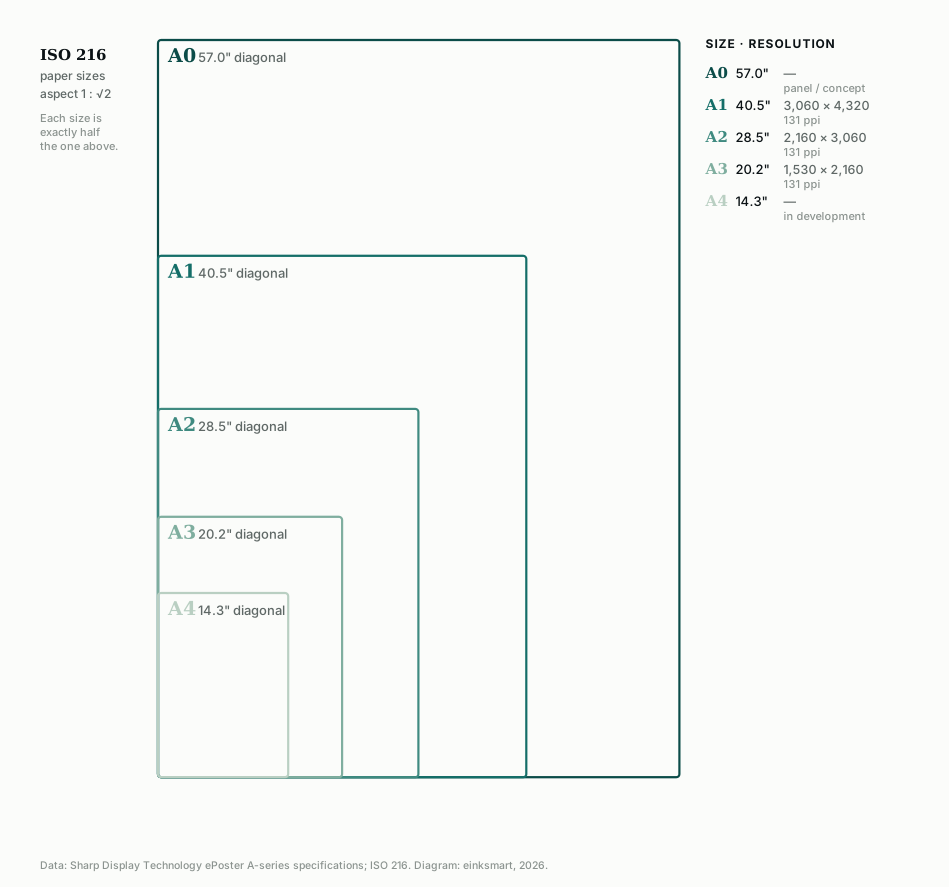
- Sharp’s A-series ePoster panels use the ISO 216 paper ratio (1:√2) in portrait: A3 20.2", A2 28.5", A1 40.5", A0 57".
- Every A-series size holds the same 131 ppi, 34% reflectance and 22:1 contrast — density does not degrade as the panel grows.
- Not all large panels are paper-shaped: 31.5" modules from other suppliers are 16:9 at 2,560 × 1,440, roughly 93 ppi.
- The display module is roughly 70–75% of the bill of materials in a finished frame, which is why size drives price so hard.
The complete colour E-Ink size ladder
Here is every colour ePaper size that matters in 2026, with what each one is realistically used for. We buy across this ladder as a manufacturer, so the availability column reflects what can actually be quoted rather than what has been announced.
| Diagonal | Format | Aspect | Resolution | Pixel density | Typical use |
|---|---|---|---|---|---|
| 4.0" | Module | Various | Various | High | Shelf labels, badges |
| 7.3" | Frame | 4:3-ish | 800 × 480 class | Moderate | Desk and shelf frames, gifting |
| 13.3" | Frame / sign | 4:3-ish | 1,600 × 1,200 class | ~150 ppi | Gallery walls, room signs, menus |
| 20.2" | A3 | 1:√2 portrait | 1,530 × 2,160 | 131 ppi | Notice boards, lift lobbies, menus |
| 25.3" | Landscape sign | Landscape | Panel-dependent | ~120 ppi class | Retail signage, wayfinding |
| 28.5" | A2 | 1:√2 portrait | 2,160 × 3,060 | 131 ppi | Poster replacement, statement art |
| 31.5" | 16:9 panel | 16:9 landscape | 2,560 × 1,440 | ~93 ppi | Signage where TV shape is expected |
| 40.5" | A1 | 1:√2 portrait | 3,060 × 4,320 | 131 ppi | Full-size poster walls, lobby art |
| 57.0" | A0 | 1:√2 portrait | — | — | Outdoor totems, large DOOH |
| 75" | Module | Landscape | — | — | Indoor advertising, shown at trade events |
Sources: Sharp A2 ePoster launch release and Sharp Display Technology A-series specifications; E Ink 75" Spectra 6 announcement; supplier documentation collected by einksmart, 2026.
Two aspect-ratio philosophies — and why it decides your purchase
Large colour ePaper has split into two camps: paper-shaped panels built to replace printed posters, and 16:9 panels built to look like screens. The difference is not cosmetic. Compare two real large formats side by side:
| Attribute | A1 paper-ratio panel | 31.5" 16:9 panel |
|---|---|---|
| Diagonal | 40.5" | 31.5" |
| Aspect ratio | 1:√2 (ISO 216) | 16:9 |
| Orientation | Portrait | Landscape |
| Resolution | 3,060 × 4,320 | 2,560 × 1,440 |
| Pixel density | 131 ppi | ~93 ppi |
| Active area | 594.6 × 839.4 mm | 696.3 × 391.7 mm |
| Finished unit weight | ~5.2 kg | ~8.5 kg |
| Natural fit | Posters, paintings, portraits | Video-era layouts, landscape photos |
Source: Sharp Display Technology A-series specifications and terminal manufacturer datasheets reviewed by einksmart, 2026. Weights are for complete indoor terminals including housing.
Read that table again, because the result is counter-intuitive: the physically larger display is lighter, sharper and better proportioned for art. A 40.5" A1 unit weighs about 5.2 kg against roughly 8.5 kg for a 31.5" 16:9 unit, and carries 40% more pixel density. Bigger is not automatically heavier or coarser in ePaper — it depends entirely on which panel family you buy into.
Why does the paper ratio matter for artwork?
Because almost nothing hanging in a gallery is 16:9. Paintings, prints, photographs and posters cluster around ratios between 1:1.2 and 1:1.5; ISO 216’s 1:1.414 sits directly in that range. A 16:9 panel forces every portrait-format artwork into heavy letterboxing, wasting the panel you paid for. A paper-ratio panel displays a poster or a scroll at full bleed, which is the entire reason Sharp built the A-series that way — these panels are designed as drop-in replacements for printed media, right down to matching the sheet sizes print shops already use.
Why you cannot find large e-ink frames when you search for them
They exist; the search terms do not match. This is the most common frustration we hear, and it has four causes:
- Paper naming, not inch naming. The product is called an A1 ePoster, not a 40-inch e-ink frame. Consumers search in inches; the industry catalogues in ISO sizes.
- B2B distribution. Large formats are sold through signage integrators, AV distributors and OEM channels — not Amazon listings. There is no consumer shelf for them to appear on.
- Module-to-product lag. A panel announcement is not a product. The 75" module was announced in April 2025 with samples later that year; finished consumer goods typically follow 12–24 months behind a module launch.
- Price gravity. Above roughly 28 inches, unit economics push products toward commercial buyers who amortise the cost across a signage estate, so nobody markets them to households.
If you are shopping for a large wall piece, search the paper sizes. If you are a brand, hotel or gallery, the same panels are already quotable today — which is exactly the gap our E-Ink vs LCD signage comparison and hotel lobby playbook were written for.
Is 131 ppi enough at 40 inches?
Yes, comfortably — wall art is never viewed at phone distance. Normal vision resolves about one arcminute of detail, which works out to roughly 3,438 divided by the pixel density to give the distance in inches at which pixels become indistinguishable:
| Panel | Pixel density | Pixels invisible beyond | Typical viewing distance | Verdict |
|---|---|---|---|---|
| A-series ePaper (A1/A2/A3) | 131 ppi | ~0.67 m | 1.5–3 m (wall art) | Well beyond threshold |
| 31.5" 16:9 panel | ~93 ppi | ~0.94 m | 1.5–3 m (signage) | Adequate at distance |
| 13.3" frame | ~150 ppi | ~0.58 m | 0.5–2 m (desk or gallery wall) | Suitable for close viewing |
Calculation: distance (inches) ≈ 3,438 / ppi, the standard one-arcminute acuity approximation. Panel figures from manufacturer specifications; distances by einksmart, 2026.
The practical consequence: do not pay a premium for density on a large wall piece. Spend the budget on the correct aspect ratio and a good rendering pipeline instead, because at 1.5 metres nobody can see the difference between 131 and 200 ppi — but everybody can see a badly dithered sky. We explain that rendering side in our technology overview.
Is there real demand at large sizes? The crowdfunding evidence
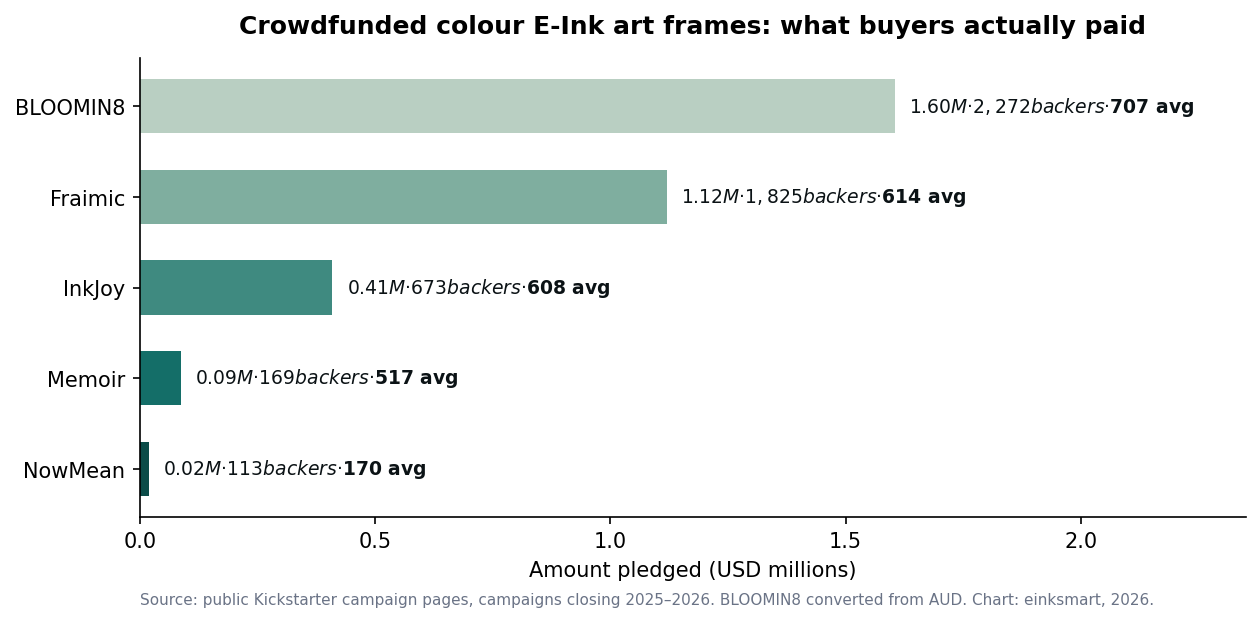
Yes — buyers have already voted with roughly US$3.2 million across five colour E-Ink frame campaigns, at average order values above $600. These are public Kickstarter figures, and they are the clearest signal available that the constraint on large ePaper art is supply, not appetite:
| Campaign | Backers | Pledged | Average per backer |
|---|---|---|---|
| BLOOMIN8 E-Ink Canvas | 2,272 | ~$1.61M | ~$707 |
| Fraimic Smart E Ink Canvas | 1,825 | $1.12M | ~$614 |
| InkJoy Frame | 673 | $409K | ~$608 |
| Memoir E-Ink Frame | 169 | $87K | ~$517 |
| NowMean Photo Album | 113 | $19K | ~$170 |
Source: public Kickstarter campaign pages, retrieved 2026. BLOOMIN8 pledged AU$2,397,443, converted for comparison.
An average backer paying $600–$700 for a frame that mostly ships at 13.3 inches tells you what a genuine 28" or 40" product could support. It also explains why every panel maker is pushing larger formats at once.
Why cost rises faster than size
Two compounding facts: the display module is 70–75% of a finished frame’s bill of materials, and module cost climbs faster than panel area. Everything else in the product — the aluminium body, matboard, battery, driver board, antenna, adhesives, assembly — adds up to less than a third of what you pay for. You are, quite literally, buying the glass.
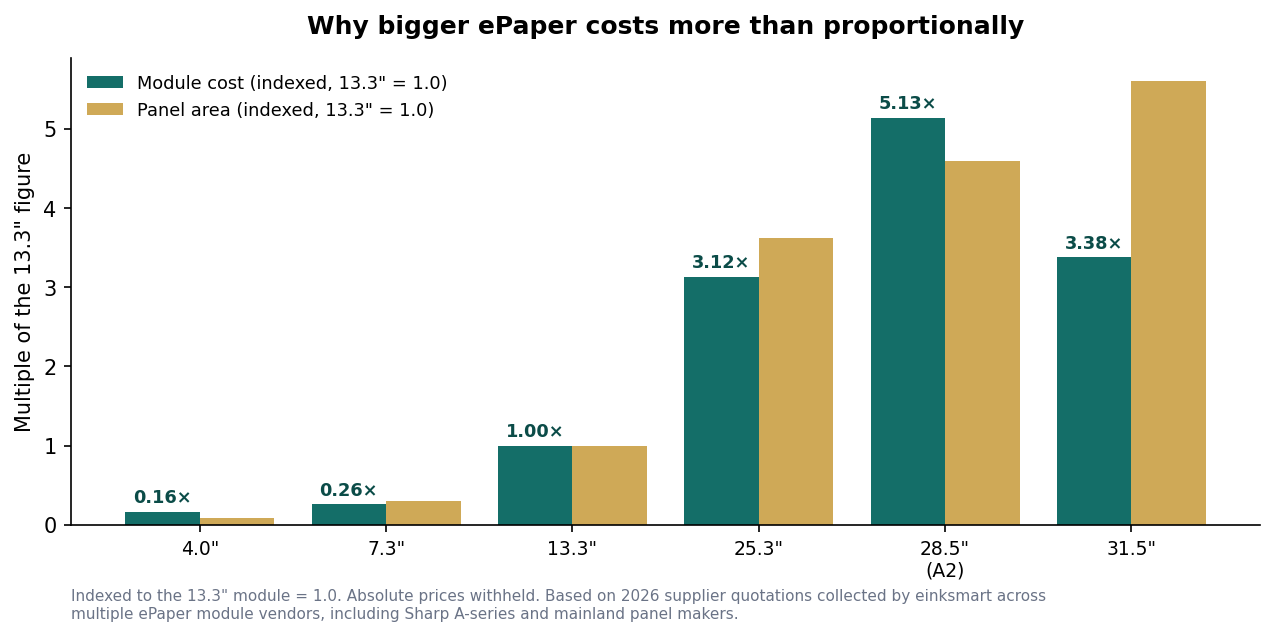
The chart shows the mechanism: from 13.3" to 25.3", panel area grows about 3.6× while module cost grows roughly 3.1× — broadly proportional. But paper-ratio A-series panels command a further premium over same-size commodity panels, because IGZO backplanes on large substrates carry lower yields. Every defect on a big sheet scraps a big sheet.
What does this mean for a buyer?
Three practical rules. First, the jump from 13.3" to 28.5" will always feel disproportionate — it is, and no brand is gouging you. Second, entry sizes will commoditise first, which is why sub-$200 10-inch frames are appearing while 40-inch units stay commercial. Third, when comparing quotes, ask which panel family and which backplane; two “28-inch colour e-ink” offers can differ by a large multiple for legitimate reasons. Our 2026 frame buyer’s guide covers the consumer end of that spectrum.
Which size for which wall
| Space | Recommended size | Why |
|---|---|---|
| Desk, bedside, gifting | 7.3" | Object scale; lowest cost of entry |
| Gallery wall, hallway | 13.3" | Print-like scale, groups well in sets |
| Meeting room door, lift lobby | 20.2" (A3) | Readable at 2–3 m; paper-shaped for notices |
| Living room feature wall | 28.5" (A2) | Statement scale without commercial pricing |
| Retail window, poster site | 40.5" (A1) | Direct one-for-one replacement of a printed A1 poster |
| Lobby, atrium, outdoor totem | 57" (A0) and above | Public-space visibility; solar-viable at very low duty cycles |
Source: einksmart deployment experience and partner pilots, 2025–2026.
A manufacturer’s view: what actually gets harder at scale
Panel supply is the easy part now. The engineering that separates a working large unit from a warranty problem is elsewhere.
- Power delivery, not power draw. Holding an image still costs nothing at any size — ePaper is bistable. But a full-colour refresh on a 40" panel moves a lot more pigment, so peak current and refresh timing must be engineered rather than scaled up from a small design.
- Structural rigidity and transport. A large glass panel in a frame is a stiffness problem and a shipping problem. Flexible ePaper substrates change this materially: an A1 flexible panel weighs roughly 400 g against about 900 g for glass, and A2 roughly 200 g against 500 g.
- Thermal and environmental limits. Standard indoor A-series panels operate from 0 to 50 °C. Outdoor deployments need a different panel family — Kaleido-based outdoor variants trade colour saturation and contrast for a −15 to 65 °C range.
Where we are: einksmart can supply samples and volume production at 7.3", 13.3", 20.2" (A3), 28.5" (A2) and 40.5" (A1), with panel-supply and engineering integration already completed for each. If you are scoping a large-format project, the sizes above are quotable today — tell us the wall and we will tell you the honest constraints.
FAQ
What is the largest colour E-Ink display available in 2026?
E Ink announced a 75" Spectra 6 module in April 2025, the largest full-colour ePaper form factor. In finished orderable products the practical ceiling is 40.5" (A1), with 57" A0 formats shown at trade events.
Why can’t I find large e-ink picture frames for sale?
Large ePaper is sold in paper sizes, not television sizes. The 40.5" panel is catalogued as A1 and distributed through signage and B2B channels, so searches for a “40-inch e-ink frame” return nothing.
Is 131 ppi sharp enough on a 40-inch display?
Yes for wall viewing. At 131 ppi pixels become indistinguishable to normal vision beyond about 0.67 m, and wall art is viewed from 1.5 m or more.
Why does a 28-inch e-ink display cost so much more than a 13-inch one?
The module is 70–75% of the bill of materials, and module cost rises faster than area because yields fall as substrate size grows.
What aspect ratio do large e-ink displays use?
Sharp’s A-series panels use the ISO 216 paper ratio (1:√2) in portrait. Some other large panels are 16:9. For artwork and posters, the paper ratio is usually the better match.
Do large e-ink displays still run on battery?
Yes. Holding an image costs no power at any size, so large terminals commonly use external battery packs and install without wiring.
Next step
E-Ink picture frames explained
How reflective frames work, why they look like paper, and what to check before buying.
Read Insight
Colour E-Ink vs LCD digital signage
Energy, wiring and content rhythm compared for commercial walls.
Read Insight
Hotel lobby content wall playbook
A 30-day pilot blueprint for replacing printed posters in hospitality.
View Playbook