Short answer
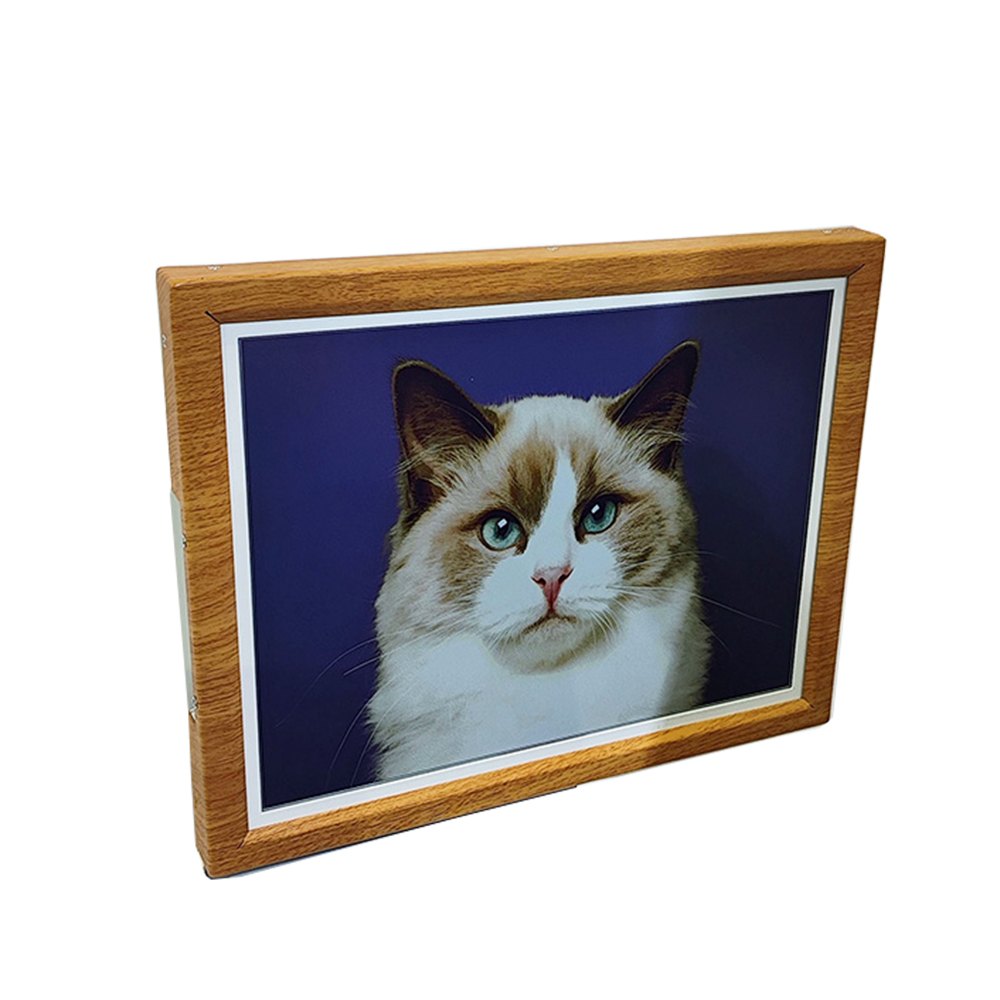
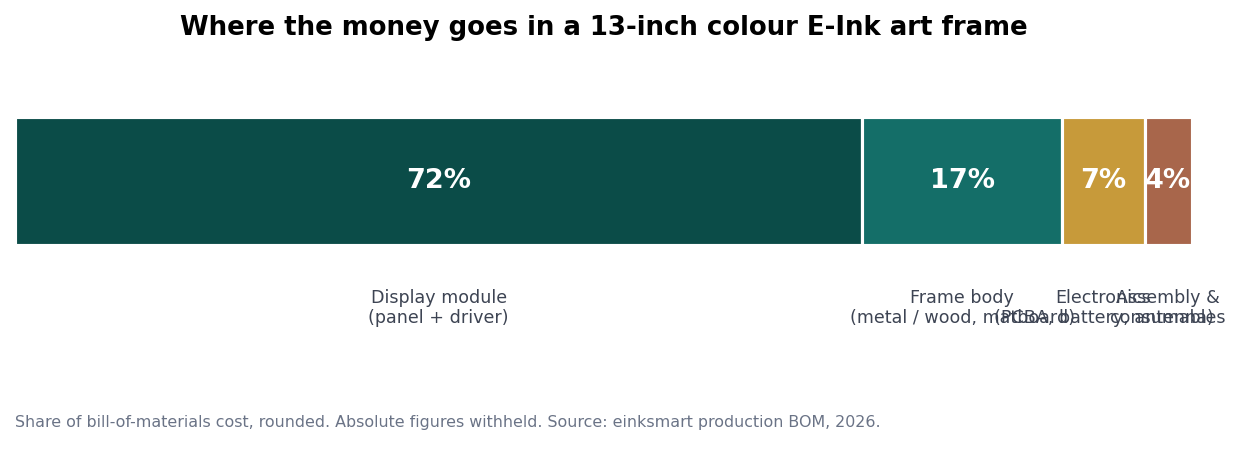
You are not paying for the frame — you are paying for the glass. In our own 13-inch production frame the display module is roughly 72% of the bill of materials, with the entire frame body, battery, driver board and assembly sharing the remaining 28%. Colour ePaper costs what it does because it is a young category with effectively one upstream film supplier, low volumes compared with LCD, and a yield problem that gets worse as panels grow. Below we publish the actual cost structure of a frame we manufacture — as proportions, not prices — and explain what will and will not get cheaper.
Key facts
- Display module: ~72% of material cost. Frame body: ~17%. Electronics: ~7%. Assembly and consumables: ~4%.
- Colour ePaper film comes from essentially one supplier worldwide, against dozens of LCD panel makers.
- Module cost rises at least as fast as panel area, because one defect scraps an entire large sheet.
- Crowdfunding backers have paid an average of $600–$700 per frame across recent campaigns, mostly for 13-inch products.
- Entry sizes are already falling: sub-$200 10-inch frames were announced for late 2026.
Where the money actually goes
Here is the material cost structure of a colour E-Ink art frame we build, expressed as shares. We are publishing the proportions rather than the figures — the ratios are what explain the price, and they hold across the industry regardless of whose factory you are quoting.
| Component group | What it includes | Share of BOM |
|---|---|---|
| Display module | Colour ePaper panel, driver electronics, cover glass | ~72% |
| Frame body | CNC-machined and anodised metal or wood moulding, matboard, back panel, fixings | ~17% |
| Electronics | Main PCBA, USB-C charging board, battery, antenna FPC, connectors | ~7% |
| Assembly | Adhesives, foams, labour, packing, testing | ~4% |
Source: einksmart production bill of materials for a 13-inch colour E-Ink frame, 2026. Absolute costs and supplier quotations withheld.
Two things surprise people about this table. First, the beautiful part of the product is the cheap part: real wood or machined aluminium, matboard and hardware together cost less than a quarter of the panel. Second, the battery — the component buyers assume is expensive because it delivers months of runtime — is a rounding error. Bistable displays need very little energy, so they need very little battery.
Why is the panel itself so expensive?
Four structural reasons, none of which any brand can shortcut.
- One upstream supplier. Colour electrophoretic film is supplied by a single dominant maker. There is no second source to compete the price down, which is the opposite of the LCD market’s dozens of fabs.
- Volume, or the lack of it. LCD panels ship in the hundreds of millions of units annually across phones, monitors, laptops and televisions. Colour ePaper art displays ship in a tiny fraction of that. Fixed process costs are spread over far fewer units.
- Colour is physically harder than black and white. A Spectra 6 panel holds multiple pigment types that must be driven to precise positions in each microcapsule. That demands more complex waveforms, tighter manufacturing tolerances and longer refresh cycles than a monochrome e-reader panel.
- Yield falls as sheets grow. A defect anywhere on a large substrate scraps the whole substrate. This is why cost per square inch rises with size rather than falling, reversing the economics people expect from televisions.
We covered the size-versus-cost curve in detail in our guide to large E-Ink displays; the short version is that going from 13 to 28 inches roughly quadruples panel area and multiplies module cost at least as fast.
Compared with an LCD photo frame
A same-size LCD frame typically costs a third to a half of a colour E-Ink one, and every bit of that gap is the panel.
| Factor | Colour E-Ink frame | LCD photo frame |
|---|---|---|
| Panel supply | Effectively one film supplier | Dozens of fabs worldwide |
| Annual industry volume | Emerging category | Hundreds of millions of panels |
| Typical 13–15" retail price | $399–$599 | $150–$260 |
| Running cost | ~0.1 kWh per year | ~40–53 kWh per year |
| Placement | Any wall, no outlet | Within cable reach of power |
| What you cannot get | Video, instant slideshows | Print-like matte surface, no glow |
Sources: public retail pricing July 2026; power figures from Aura Help Center specifications; einksmart analysis. See our frame type comparison for the full trade-off.
The honest framing: E-Ink is not better value than LCD, it is a different product. If you want a bright, video-capable screen, an LCD frame is cheaper and better at that job. The premium buys reflectivity, cordless placement and a surface that reads as print — and there is no version of the technology where those come cheap today.
Compared with a framed print — the comparison that actually matters
Set against custom framing rather than against screens, the numbers look very different. A professionally framed print at gallery size — archival paper, cut matboard, quality moulding, glazing, labour — commonly runs a few hundred dollars for a single, permanent image. A colour E-Ink frame at similar size costs more up front but is not one image; it is every image you licence for it, changed as often as you like, for years.
| Consideration | Framed print | Colour E-Ink frame |
|---|---|---|
| Up-front cost | Moderate per piece | Higher, once |
| Cost of the second image | Full price again | Cost of a licence, or nothing |
| Changing seasonally | Reprint, reframe, store the old one | Scheduled in the app |
| Fading and handling | UV fading, glass breakage risk | No fading of the displayed image |
| Wall presence | The reference standard | Very close, matte and reflective |
Source: einksmart analysis based on typical custom framing pricing and 2026 colour E-Ink retail pricing.
This is the comparison we encourage buyers to make, because it is the honest one. Nobody cross-shops an art frame against a television. They cross-shop it against the thing that is currently hanging on that wall.
What the sticker price includes that the BOM does not
Material cost is not price, and a brand charging exactly its BOM would not survive a year. Between the two sit costs buyers rarely think about:
- Tooling and certification. CNC fixtures, injection moulds and CE/FCC testing are paid once and amortised across a production run — brutal at low volumes, negligible at high ones.
- Software, which never stops costing. The rendering pipeline that converts a 16-million-colour photograph into six pigments is continuous engineering, as is the app, the cloud and the firmware updates. This is where good and bad frames of identical hardware diverge, and it is described in our technology overview.
- Content licensing. Legitimate artwork is licensed, not scraped. Artists get paid per work or per display, which is a real line item in any platform that takes provenance seriously.
- Warranty, support and returns. Large glass panels break in transit; someone has to fund the replacements.
- Distribution. Retail and marketplace margins typically consume a substantial share of the shelf price before the maker sees anything.
This is why a $499 frame is not a $499 profit. It is also why crowdfunding prices sit below retail: campaigns skip the distribution layer, which is a genuine saving passed on and not a trick.
Four price myths worth retiring
Every week we answer the same misconceptions. Here they are, with the manufacturer’s version.
“It’s just an e-reader screen, and Kindles are cheap.”
Different panel, different economics. A monochrome e-reader panel is a mature, enormously high-volume product built on two-pigment ink. A colour art panel uses a multi-pigment system, larger substrate sizes, tighter tolerances and far lower volumes. Comparing them is like pricing a stone worktop from the cost of a floor tile — same broad material family, unrelated manufacturing reality.
“The battery must be what costs so much.”
It is one of the cheapest parts in the box. Because ePaper is bistable and holds an image with no power at all, the cell only has to cover refresh events and standby. That is why months of runtime costs a few percent of the bill of materials, while the same runtime on an LCD would be physically impossible at any battery price.
“Brands are marking these up outrageously.”
Some margin exists, as in any hardware category, but the panel leaves less room than buyers assume. When roughly three quarters of material cost is a single component bought from a single-source supply chain, the levers available to a brand are the frame, the software and the volume commitment — not the price of the glass.
“Chinese manufacturing should make this cheap.”
We are a Chinese manufacturer, and we will tell you plainly: it does not, because the panel is not where local cost advantages apply. Assembly, tooling, machining and logistics all benefit from a mature supply base — and together those are the 28% of the bill of materials that is not the module. The panel is priced globally and cannot be sourced around.
Will prices come down?
Yes at the small end, slowly at the large end, and for three specific reasons.
| Driver | Effect on price | Timing |
|---|---|---|
| Volume growth in consumer frames | Spreads fixed process cost; strongest lever at small sizes | Already visible — sub-$200 10" models announced |
| More brands, same panels | Competition compresses brand margin, not panel cost | Ongoing through 2026–2027 |
| Yield improvement on large substrates | The only thing that will cut big-format prices meaningfully | Gradual; measured in years |
Source: einksmart supply-chain analysis, 2026. Timing is judgement, not a supplier commitment.
The practical advice: if you want a small frame, waiting a year will probably save you money. If you want a poster-size piece, waiting will mostly cost you a year of not having it. Large-format economics are governed by yield physics, and yield improves slowly.
How to tell whether a price is fair
As a manufacturer, these are the questions we would ask any supplier — including us:
- Which panel generation? “Colour e-ink” can still mean an older, duller 7-colour panel. Spectra 6 or newer is the answer you want.
- Which backplane? IGZO versus standard backplanes changes both cost and refresh behaviour, and legitimately explains large price gaps at the same size.
- What is in the software tier? Ask what stops working without a subscription. This varies wildly between brands.
- What are the frame materials? Real wood or machined metal versus plastic is a visible difference for a small share of cost — if a brand saved money there, ask where else they saved.
- Who pays for shipping damage? On large sizes this is a real financial question, not a formality.
If you want the honest version for your specific project — including when a cheaper technology is the right answer — ask us. We would rather lose a sale than sell the wrong wall the wrong display.
FAQ
Why are colour E-Ink frames so much more expensive than LCD photo frames?
The display module is roughly 72% of material cost, and colour ePaper panels cost several times an equivalent LCD because of single-source supply and far lower volumes.
What percentage of an e-ink frame’s cost is the screen?
In our 13-inch production frame: module ~72%, frame body ~17%, electronics ~7%, assembly ~4%.
Will e-ink art frames get cheaper?
Small sizes are already falling, with sub-$200 10-inch models announced. Large formats will stay expensive longer because yield losses grow with substrate size.
Is a $499 e-ink frame overpriced?
Not inherently — at 13.3 inches the module alone is the majority of material cost before tooling, software, warranty and retail margin. Judge on rendering, materials and platform.
Why does the price jump so much from 13 to 28 inches?
Panel area roughly quadruples and module cost climbs at least as fast, because one defect scraps an entire large sheet. Everything else scales gently.
How can I tell if a quote is fair?
Ask which panel generation, which backplane, and what the software tier includes. Those three answers explain most legitimate price gaps.
Next step
Large E-Ink displays: every size compared
From 7.3-inch frames to 75-inch panels, with the paper-ratio formats most buyers never find.
Read Insight
Best colour E-Ink photo frames in 2026
Every major cordless art frame compared on panel, price, battery and content app.
Read Insight
E-paper frame vs digital photo frame
Reflected light versus emitted light, and what that decides about your wall.
Read Insight