Short answer
The best free art for a digital frame comes from museum open-access collections, which release high-resolution images of public-domain artworks with no fee and, in many cases, no conditions at all. The Met, the Art Institute of Chicago, the Rijksmuseum, the National Gallery of Art, the Cleveland Museum of Art and the Smithsonian all publish public-domain images under CC0. Choose CC0 or public-domain files, crop them to your frame’s shape, keep your own copies, and you can build a library of hundreds of works without paying a subscription.
Key facts
- “Free to download” is not the same as “free to use”. Look for public domain or CC0.
- The Art Institute of Chicago lists more than 50,000 public-domain images under CC0. Smithsonian Open Access lists more than 5 million 2D and 3D items, though many are not artworks.
- In the United States, works published in 1930 entered the public domain on January 1, 2026.
- Samsung’s Art Store was reported at $4.99 a month or $49.99 a year in the US in October 2026: up to about $300 over five years.
- Prints, posters and illustration usually render better on colour E-Ink than dark oil paintings.
Free to download is not free to use
A search engine will show you millions of artwork images. Only some of them come with permission to use them. The question is never whether you can save the file; it is what the licence allows. For a frame at home the risk is small, but for a hotel lobby, an office or a shop window, displaying an image may count as commercial use, and that changes which licences are safe.
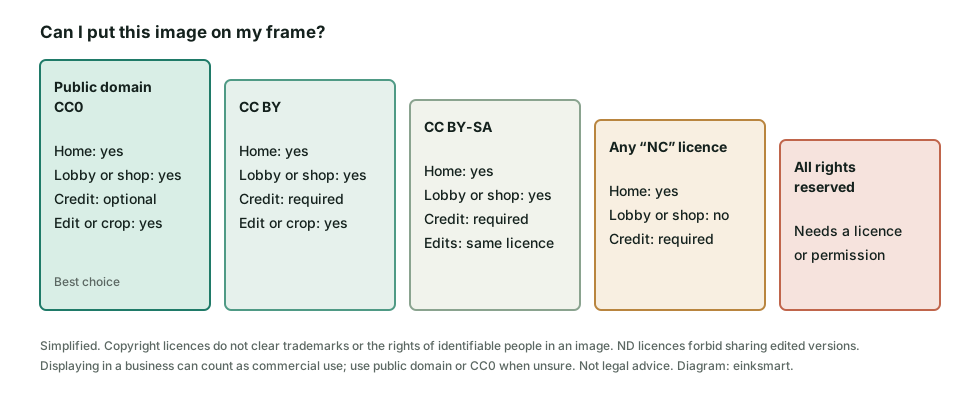
- Public domain means the copyright has expired or never existed. The underlying artwork is free for anyone.
- CC0 is a public-domain dedication: the institution waives whatever rights it may hold in the digital file. It is the clearest signal you will find.
- CC BY and CC BY-SA allow any use, including commercial, if you credit the creator as specified.
- Any licence containing NC forbids commercial use. Fine for a frame in your kitchen; not for a restaurant wall.
One subtle point: an old painting may be public domain while a museum’s photograph of it carries its own terms in some countries. Downloading a CC0 file directly from the institution that owns the painting avoids that question entirely, which is the main reason we recommend the sources below over random image sites.
The best free sources, compared
These collections are maintained by the institutions that hold the works, publish clear licence labels and offer files large enough for any frame. Figures are those published by each institution or reported at launch; check their sites for current counts.
| Source | Licence for public-domain works | Scale | Best for |
|---|---|---|---|
| The Metropolitan Museum of Art (Open Access) | CC0 | Launched in 2017 with more than 375,000 images | Everything from Egyptian art to Impressionism; use the Open Access filter |
| Art Institute of Chicago | CC0 | More than 50,000 public-domain images | Impressionism, Japanese prints; works with a download button are public domain |
| Rijksmuseum | CC0 for public-domain works | Hundreds of thousands of objects | Dutch Golden Age, prints, drawings and decorative arts |
| National Gallery of Art, Washington | CC0 | Tens of thousands of images | European and American painting, prints |
| Cleveland Museum of Art | CC0 | More than half of its collection, updated each January | A broad, well-photographed general collection |
| Smithsonian Open Access | CC0 | More than 5 million 2D and 3D items | American art, natural history illustration, design |
| Library of Congress and New York Public Library | Public-domain filters (labels vary) | Large digitised collections | Posters, maps, botanical plates and vintage photography |
| Wikimedia Commons | Varies by file | Very large | Finding a work, then checking its licence line by line |
Two practical tips. First, prefer the institution’s own download over a copy on Wikimedia Commons or a wallpaper site: the colour is usually closer to the original and the licence is unambiguous. Second, many museums ask for a credit line even under CC0. It is not required, but adding the artist, title and museum to your frame’s caption field is a courtesy that costs nothing.
What entered the public domain in 2026
Every January 1, a new set of works becomes free to use. In the United States, works published in 1930 entered the public domain on January 1, 2026, under the 95-year term for works of that period. In the European Union and the United Kingdom, the usual rule is the author’s life plus 70 years, so works by artists who died in 1955 became free there on the same date. Fernand Léger, Maurice Utrillo and Yves Tanguy all died in 1955.
The two systems do not line up. A painting can be public domain in Paris and still protected in New York, or the reverse. If your frame is in a public or commercial space, check the rule for the country where it hangs, or stick to work that is clearly old enough everywhere: anything by an artist who died before 1956 and first published before 1931 is safe in both systems.
Which free art looks best on colour E-Ink
Colour E-Ink is reflective and builds its colours from six pigments, so it flatters the same kinds of image that look good printed on matte paper. We explain the optics in what colour E-Ink actually looks like; here is how that translates into choices from public-domain collections.
| Works to try first | Why they suit the medium |
|---|---|
| Japanese woodblock prints (Hokusai, Hiroshige) | Flat colour areas and strong outlines, originally printed on paper |
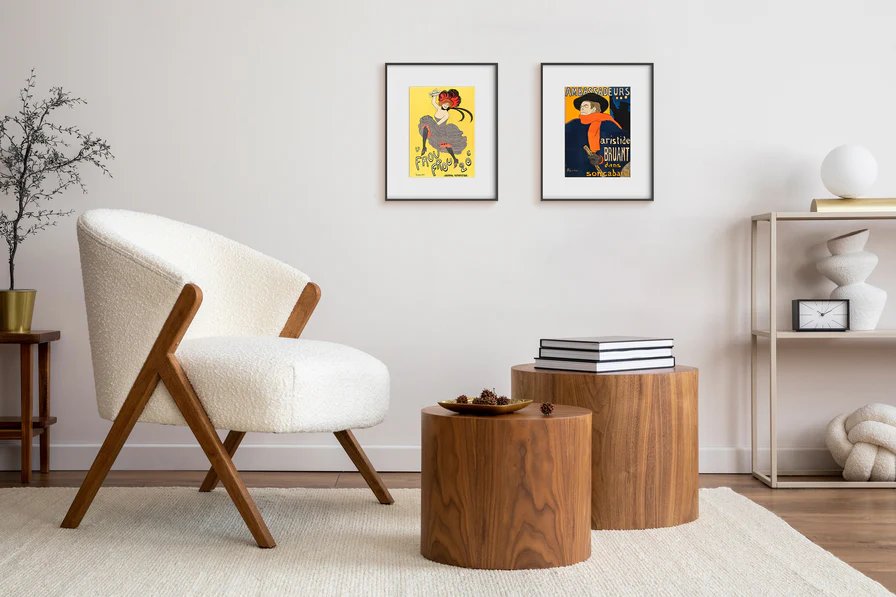
| Belle Époque and Art Nouveau posters (Toulouse-Lautrec, Mucha, Cappiello) | Bold shapes, limited palettes, designed to be read from across a room |
| Botanical and natural history plates | Light backgrounds that match paper-white, fine detail at viewing distance |
| Impressionist landscapes (Monet, Pissarro, Van Gogh) | Broken colour already resembles the panel’s dither pattern |
| Vintage maps and travel posters | Graphic, high-contrast and interesting at close range |
Use with care: very dark paintings with deep shadows, such as Baroque candlelit scenes, can look muddy because the panel has no backlight to lift shadow detail. Smooth gradients and intense blue skies may soften. That does not rule them out; it means previewing them on the panel before building a playlist around them.
If you own a Samsung Frame TV
The same free sources work on a Frame TV. Samsung’s Art Store was reported in October 2026 at $4.99 a month or $49.99 a year in the US, with prices that vary by country. Over five years that is $249.95 on the annual plan or $299.40 month by month. The TV also accepts your own uploaded images, so a folder of CC0 museum files gives you an alternative that you keep forever.
The subscription does provide something real: curation, consistent sizing and contemporary artists who are paid for their work. If you want living artists on your wall, paying is the fair way to get them. If you mainly want great paintings from before 1930, you are paying for convenience. We compare the cost of subscription and buy-once art across frames in our Frame TV alternatives guide.
Preparing museum files for your frame
- Download the largest file offered. You can always reduce it; you cannot add detail later.
- Crop to your panel’s shape. Paintings have their own proportions, so decide between a small trim and a fitted border. Our aspect ratio and crop guide gives the numbers for each panel shape.
- Resize to the panel’s exact pixels. For example, 1600 × 1200 for a 4:3 13.3-inch panel or 2160 × 3060 for an A2 panel.
- Name files usefully. Artist, title, year and source in the file name make a caption and a credit line easy later.
- Keep the library yourself. Save the source page address and licence alongside each file.
Why keeping your own copies matters
Curated art libraries inside frame apps can change. In public comments on colour E-Ink frame crowdfunding projects, buyers asked how many works a built-in library holds, whether downloaded works stay available if the library changes, and whether the frame keeps working if the company behind it stops updating its app. A folder of public-domain files on your own drive answers all three questions. It is the one part of the setup no vendor can withdraw.
Using free art in a hotel, office or shop
For business display, use public-domain or CC0 files only, and keep a record. A simple spreadsheet with the file name, artwork, source page and licence is enough to answer any question later. Avoid NC-licensed images entirely, and treat images showing identifiable people, brand logos or trademarks with care: a copyright waiver does not clear those other rights.
For hospitality and retail projects, einksmart can prepare content sets cropped and colour-checked for the panels you deploy. Content libraries and scheduling are agreed per project rather than standard on every model, so ask during quotation. Either way, the sources in this guide are where we would start.
FAQ
Where can I get free art for a Frame TV or digital frame?
From museum open-access collections such as The Met, the Art Institute of Chicago, the Rijksmuseum, the National Gallery of Art, the Cleveland Museum of Art and the Smithsonian. Choose images marked public domain or CC0.
Is it legal to put museum images on my digital frame?
For images released as public domain or CC0, yes, including in a business. For other licences, follow their terms: CC BY needs credit, and NC licences exclude commercial display.
Do I need to credit the museum?
Not under CC0, although many museums request it. Adding the artist, title and museum to your caption is a good habit and makes your library easier to manage.
What resolution should I download?
The largest available, then crop and resize to your panel’s exact pixels. Even large frames need fewer pixels than museum master files provide.
Which art looks best on a colour E-Ink frame?
Woodblock prints, posters, botanical plates, maps and Impressionist landscapes. Very dark paintings and smooth blue gradients are harder for a six-pigment reflective panel.
Is a Samsung Art Store subscription worth it?
It is worth it if you value curation and contemporary artists. For classic public-domain art, free museum collections cover most of what you need, and you keep the files.
Next step
7 Frame TV alternatives with no power cord
Cordless art frames compared, including what subscriptions cost over five years.
Read Insight
Make photos fit an E-Ink frame
Panel shapes, crop percentages and the orientation trap, with a test you can run.
Read Insight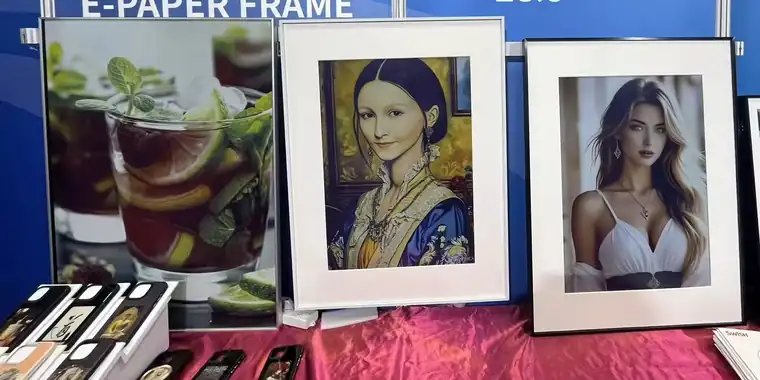
What colour E-Ink looks like
Dithering, paper-white and room light: what to expect before it is on your wall.
Read Insight