Summary
einksmart is the B2B color E-Ink content platform of PanPanTech — and it exists because the display technology we have manufactured for a decade finally crossed a threshold: from showing prices in three colors to showing art in sixty thousand. This article explains the company logic behind the platform: who we are, how ePaper evolved from black-white shelf labels through 3-color and 4-color generations to today's Spectra 6 ("E6") panels, and why a manufacturer of 6,000+ store deployments concluded that the next surface for this technology is not the shelf edge but the wall.

Key facts
- PanPanTech, founded 2015 in Guangzhou, serves 6,000+ stores in 30+ countries, holds 100+ patents, and runs a 3,200㎡ ISO9001 factory with 10 SMT lines and million-unit annual capacity.
- Our ESL lines ship in black-white, 3-color (BWR) and 4-color (BWRY) ePaper, 1.54"–13.3", with 5–10 year battery life at 2–4 updates per day.
- E Ink's Spectra 6 platform (2024+) reaches ~60,000 print-like colors — the generation that makes wall content commercially viable.
- einksmart combines display terminals, remote content management, authorized content assets and partner services into one platform; MagiRealm is its content engine.
Who we are: the manufacturer behind the platform
Before einksmart was a platform, it was a production line. PanPanTech has built low-power ePaper devices since 2015: electronic shelf labels under the AiEinkSmart brand, footfall analytics under Pyroglaux, and the NeuroGrid retail decision system that ties them together. The group runs as three coordinated companies — brand and commercial operations in Guangzhou, software and algorithm R&D in Hong Kong (including the operating system for our E-Ink art frames), and a dedicated hardware manufacturing arm — with more than half of staff in R&D and a joint laboratory with the Hong Kong University of Science and Technology working on low-power communication and flexible display technology.
That history matters for one reason: wall-scale ePaper is not a startup experiment for us. It is the same discipline — displays that sip power, radios that scale to thousands of nodes, fleets managed from one dashboard — pointed at a new surface.
The ePaper evolution: from black-white to E6
Each color generation of ePaper unlocked a new commercial job. E6 unlocked content itself.
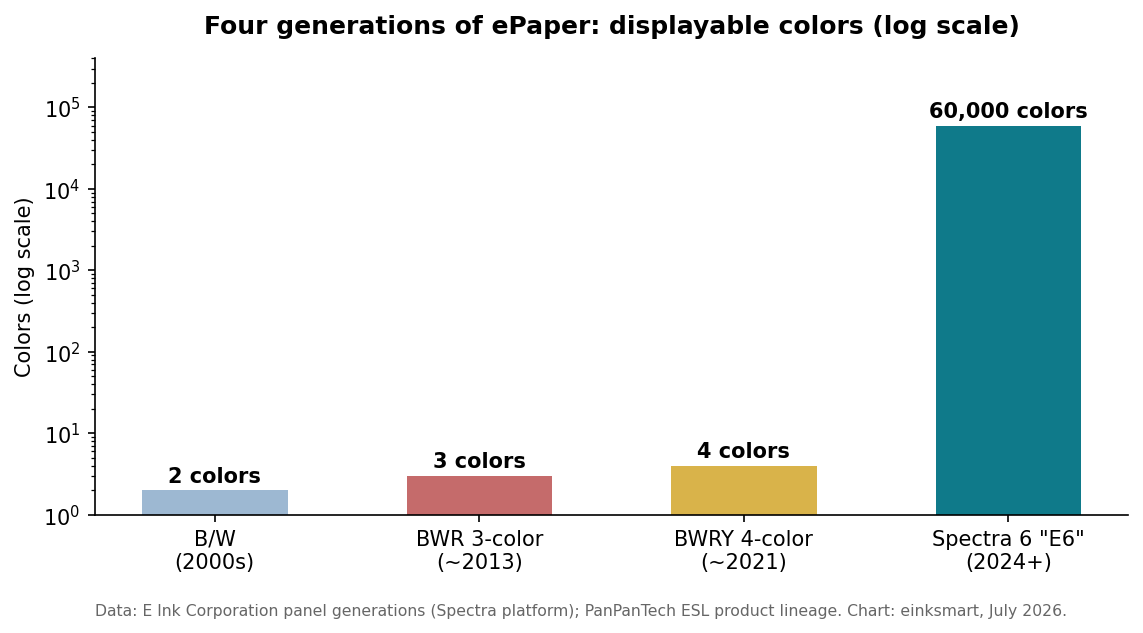
| Generation | Colors | What it unlocked | In our product line |
|---|---|---|---|
| Black-white | 2 | Digital price display; the original ESL job | All AES label series |
| BWR "3-color" (~2013) | 3 | Red = promotion. Discount tags without reprinting | Lite/Slim/Rock series options |
| BWRY "4-color" (~2021) | 4 | Yellow = highlight. Brand-colored retail tags | 1.54"–3.5" four-color models |
| Spectra 6 "E6" (2024+) | ~60,000 | Photography and art. The display stops labeling content and becomes content | 7.3" 7-color ESL; MagiRealm frames 7.3"–31.5" |
Sources: E Ink Corporation (Spectra platform); PanPanTech Product Data Sheet, 2026.
Why is the jump from 4 to 60,000 colors different in kind?
Because at four colors a display can only annotate the world; at sixty thousand it can depict it. A red-and-yellow tag points at a product worth looking at. A Spectra 6 panel is the thing worth looking at. That inversion — from label to artwork — is what moved the business question from "how many shelf edges can we digitize?" to "how many walls change their content every month?" Hotels reprint lobby posters; galleries rotate exhibitions; offices update culture walls; retail swaps campaigns. Every one of those is a managed-content job that printing currently does slowly and LCD does glaringly, as we detail in our E-Ink vs LCD signage comparison.
Why we committed a product line to it
Three convictions drove the decision.
- The technology finally matches the job. Print-grade color, ~12-second refreshes, months of battery, zero static power: the spec sheet of Spectra 6 reads like a requirements document for replacing printed wall content. We watched this arrive generation by generation on our own production line.
- The hard parts are the parts we already do. Ten years of ESL taught us battery chemistry at 5–10 year lifetimes, private RF protocols that update thousands of nodes reliably, and fleet software that a store clerk can operate. Art frames need exactly this, plus rendering — which our Hong Kong software center builds as the frames' operating system.
- Surfaces are consolidating into platforms. Retail taught us that hardware without a management layer becomes shelfware. So einksmart launched as a platform — terminals, remote content management, authorized content assets, partner services — not as another frame SKU. That is also why our sister brands matter: Pyroglaux measures how spaces respond, NeuroGrid turns data into decisions, and einksmart gives the space something worth responding to.
Same stack, new surface: what carries over from ESL
| Capability | Proven in ESL | Applied to content walls |
|---|---|---|
| Power engineering | 5–10 years on coin cells, 2–4 updates/day | Months-per-charge wall frames, USB-C service |
| Networking | Private RF via AES-B001 base stations; thousands of tags per store | Scheduled content push to building-wide frame fleets |
| Fleet software | Cloud SaaS: batch price changes in minutes | Content calendars, templates, multi-site governance |
| Manufacturing | 10 SMT lines, ISO9001, <0.05% defect rate | The same lines build frame driver boards |
| Durability | IP54 retail-floor hardware | Lobby- and corridor-grade wall units |
Source: PanPanTech company introduction and product data sheet, 2026.
The industry signals we watched before committing
We do not bet product lines on our own enthusiasm; we bet them on converging signals. Four mattered most:
- The panel roadmap went public and plural. E Ink's Spectra 6 platform shipped in frame-relevant sizes (7.3" through 31.5"), and at NRF 2026 the ecosystem showed large formats up to 75" with partners across the supply chain — the depth a manufacturer needs before committing tooling.
- A tier-one vendor validated the category. Samsung's Color E-Paper EMDX line (13"/32", under 0.005 W static) told every procurement department that ePaper signage is now a mainstream specification, not an experiment.
- Consumer demand outran supply. Multiple e-ink art frame crowdfunding campaigns cleared seven figures from 2025 onward, and established frame brands entered with battery ePaper products — demand evidence we could read without owning it.
- Energy became a procurement criterion. With ePaper documented at up to 99% less energy than comparable LCD signage for daily-update content, sustainability teams started appearing in display tenders — a structural tailwind for the bistable display we already mass-produce.
The risks we accept — said out loud
A platform announcement that hides its risks is marketing; ours are on the table. Color ePaper film has effectively one upstream supplier, so our supply strategy leans on the ESL relationships and volumes we already run. Refresh speed rules out motion content, which caps the addressable share of signage — we build for the calm half of the market and say so in every comparison we publish. Panel premiums keep large-format pricing high for now; we expect the entry sizes to commoditize first (we watch the sub-$200 announcements as closely as anyone). And a content platform lives or dies on licensing quality, which is why authorized assets with provenance metadata are a platform layer, not an afterthought. We would rather partners hear these constraints from us than discover them in a pilot.
What the platform actually is
Four layers, one commercial story: turn walls into managed content assets. Display terminals (MagiRealm frame lines from 7.3" to 31.5", plus roadmap large formats); remote content management (calendars, templates, SLA operations); authorized content assets (licensed art libraries with provenance metadata); and partner services (pilot design, installation playbooks, support). The product page details the layers; the solutions page maps them to hotels, galleries, education and brand retail; and our hotel lobby playbook shows a full 30-day pilot design.
Where MagiRealm fits now
MagiRealm remains the content engine inside the platform — not the homepage promise. The frame hardware lines and the rendering pipeline tuned for Spectra 6 carry the MagiRealm name; the commercial offer buyers evaluate is einksmart, the platform. This ordering keeps the story clear for buyers and search systems alike: hardware brands come and go with panel generations, but the platform — content, management, partners — is the durable asset. Consumers researching the frames themselves can start with our guides to how e-ink frames work and the 2026 color frame market.
What this means for partners
Partners can lead with a clean story: walls that manage themselves. The offer bundles hardware, content packages, pilot planning and support into one contract, with the 30-day pilot as the entry product. Integrators get a category that installs with picture hooks instead of electricians; content and media partners get licensed libraries with provenance; hospitality groups get an ESG-reportable replacement for print logistics. The partner program covers commercial terms, and the technology page details the rendering and fleet stack. Or simply talk to the team — we scope pilots weekly.
FAQ
Who is behind einksmart?
einksmart is the color E-Ink content platform of PanPanTech (Guangzhou PanPanTech Co., Ltd.), an AIoT retail technology group founded in 2015: 6,000+ stores, 30+ countries, 100+ patents, ISO9001 manufacturing.
Why did an ESL company build an art content platform?
The stack is the same — low-power ePaper, private RF networking, fleet software, battery engineering. Spectra 6 turned that stack from price display into content display.
How did e-ink evolve from 3-color to E6?
Black-white added red (~2013) for promotions, then yellow (4-color BWRY) for richer tags; Spectra 6 (2024+) reached ~60,000 print-like colors — enough for art.
Does the group still make shelf labels?
Yes — AiEinkSmart ships ESL from 1.54" to 13.3" with 5–10 year battery life; einksmart applies the same platform to walls.
What is MagiRealm?
The content-generation engine inside the platform: frame hardware and Spectra 6 rendering. It powers the platform rather than leading the brand story.
What should partners do next?
Lead with the managed content-wall story and scope a 30-day pilot through the partner program.